A Bloomington marathon or 5K needs at least one toilet per 20 to 40 runners at the start line, following the same ratio OSHA uses for job sites under 1926.51(c). Bloomington Porta Pros builds race-day layouts around start corrals, aid stations and the finish chute.
Start with the field size and work backward. OSHA 1926.51(c) sets 1 toilet for 20 workers or fewer, then 1 toilet seat and 1 urinal per 40 people up to 200, and Bloomington Porta Pros applies that same math to runners clustered at a start line. A 500-runner 5K through Bloomington usually needs units bunched at the start, a smaller cluster near mile two, and a bigger group at the finish where people linger. Spread them wrong and you get a line at the start and empty units on the back half of the course. Our event restroom rental planning walks race directors through corral counts before delivery week. For bigger fields, a standard porta potty rental at the start and an ADA accessible porta potty near the finish line covers most permit reviews. ADA Standards section 213.2 requires at least 5 percent of a cluster to be accessible units, never fewer than one, so a bank of eight standards needs one ADA unit minimum. If your race also draws a crowd for a post-race festival, check our festival restroom rental page for family and vendor-zone counts. Races with a running clock and a hard course-clear time benefit from a written porta potty rental checklist so nothing sits half-set when the gun goes off.
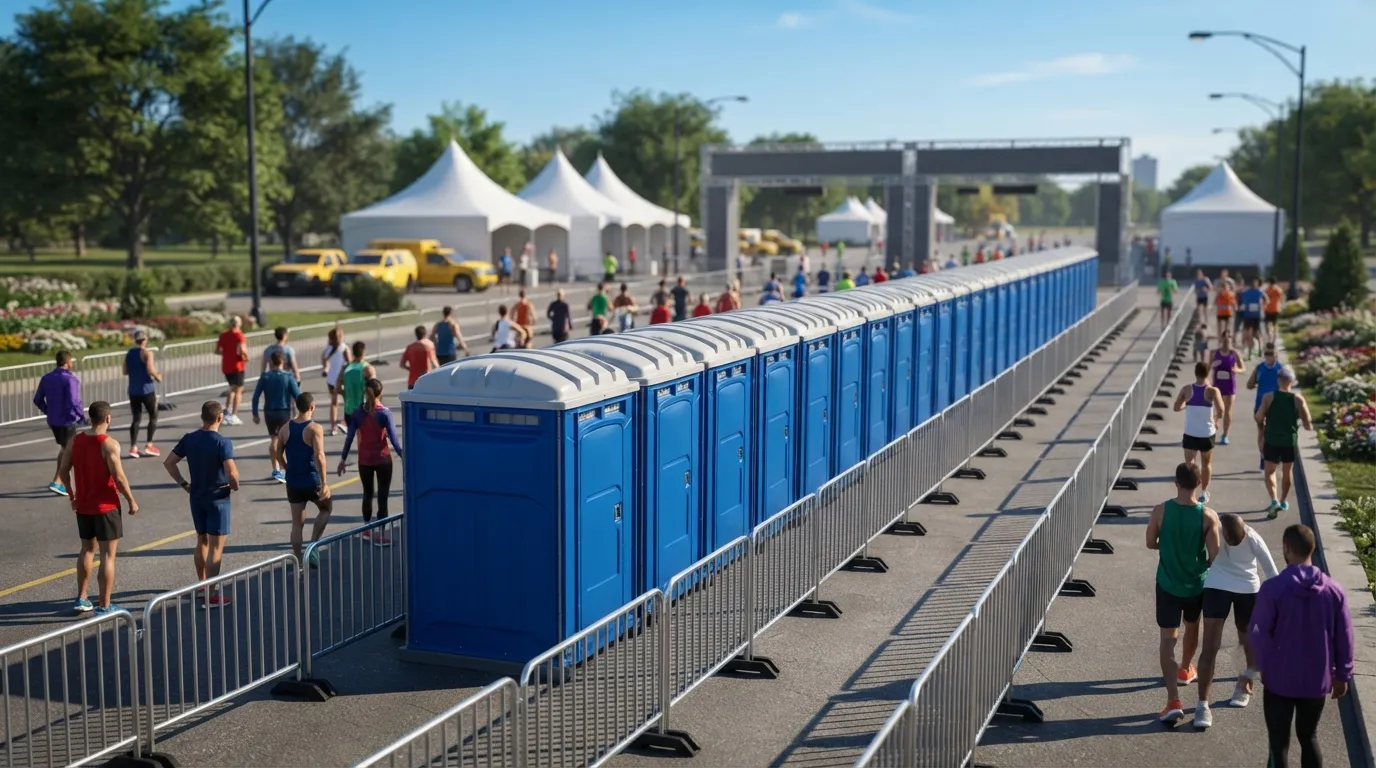
Placement drives everything else. Units need level ground, a service truck path, and clearance from timing tents and finish-line cameras. Our porta potty placement guide covers ground rules that apply whether you're setting up in a downtown Bloomington park or a rural start line outside town. Aid stations with timing equipment or announcer sound systems often run off a generator or a temporary power pole, and how to brace a temporary power pole matters more on race day than almost any other setup detail: guy the pole with at least two lines set at opposing angles, stake below the frost line where the ground allows it, and never let cable slack pull the pole sideways when a fun-run crowd bumps past it. A pole that leans mid-race becomes a hazard right where volunteers and runners are thickest. Pair power with a light tower rental for pre-dawn starts, common with marathons that kick off before sunrise to beat summer heat. If your course crosses gravel or turf that a truck can't reach directly, flag that during the site walk, since a roll-off or trailer delivery needs about 60 feet of straight clearance behind the truck and portable units need similar access for weekly service trucks under the ANSI/PSAI Z4.3 service interval standard.
Handwashing, fencing and waste hauling round out a full course plan. A handwashing station rental belongs next to any food or medical tent, and under 29 CFR 1910.141(d)2 those stations need soap and towels or a hand-drying device, not just sanitizer. Aid stations handing out gels and electrolyte cups generate real trash volume, and a 10 yard dumpster rental at the finish festival keeps cups and wrappers from blowing across the finish chute. Courses that cross private farmland or closed roads often need temporary fence rental or crowd control barrier rental to keep spectators off the running line, and OSHA 1926.202 requires barricades used for worker or crowd protection to meet ANSI D6.1. If your race base camp needs a command post, a mobile office trailer rental gives timing staff and medical volunteers a dry, powered space near the finish. Races that draw a Bloomington crowd from Ellettsville, 8.7 miles northwest, or Smithville-Sanders, 8.1 miles south, should plan parking-adjacent restroom clusters since those runners often park off-site and walk in. For multi-day festival races, our luxury restroom trailer or 4 stall restroom trailer options give VIP or sponsor tents a nicer restroom than a standard unit row.
Book as soon as your course map and expected field size are set, ideally weeks out for a Bloomington race with more than a few hundred runners. Delivery scheduling, ADA unit counts and power pole placement all take longer to coordinate for road closures than for a fixed venue.
Yes. Bloomington Porta Pros services starts and finish lines within driving range of town, including areas near Stanford, 9.5 miles southwest, and Martinsville, 20.0 miles north. Confirm truck access early since remote fields sometimes lack a clear delivery path.
Generally yes. ADA Standards section 213.2 calls for at least one accessible unit in any cluster, regardless of race size. Our ADA accessible porta potty page covers clear width and turning space requirements for placement.
A standard unit runs a event rate for a single race day, and weekend races cost more per unit than a single-day event. See our porta potty rental cost page for full pricing by duration and unit type.
Yes, and each aid station should get its own small cluster rather than one large bank at the start. Spreading units along the course, following how many porta potties do I need guidance, keeps lines short at every mile marker.
Yes. Bloomington Porta Pros delivers marathon and race restrooms across Bloomington and the surrounding metro, with same-day and next-day drop-off available on most orders.
Pricing depends on the unit and how long you need it. See our cost breakdown and request a free quote for an exact figure.
Standard rentals include scheduled service — a pump-out, a clean, a restock and fresh deodorizer. Busy or hot-weather sites can be serviced more often.
Call now or request a free quote — clean units, on-time delivery, transparent pricing.